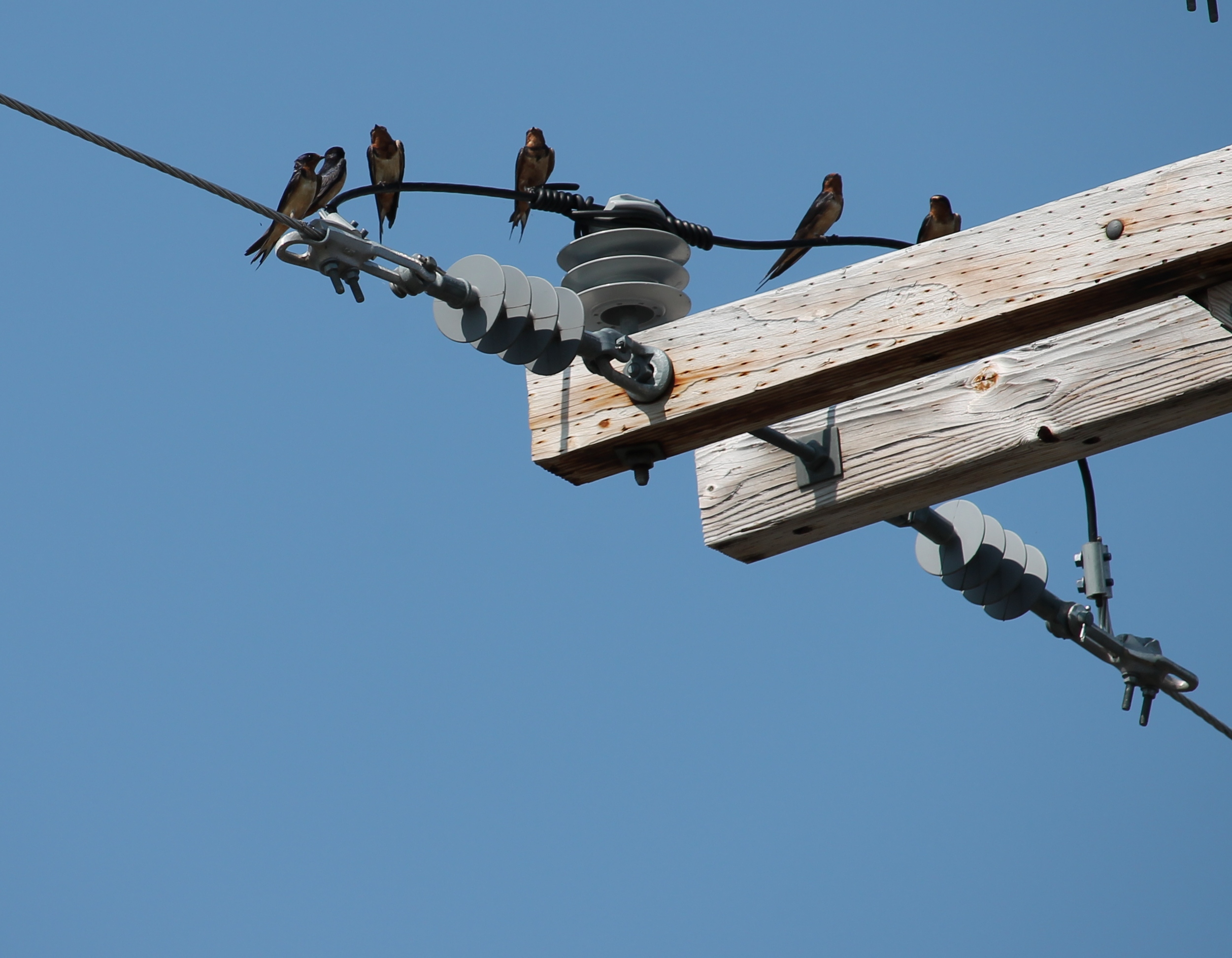
Meet the barn swallow, a fairy-like bird with cobalt blue wings and tawny white and brown below. A resident of open fields and water bodies, these birds are agile and fast, darting up and down and swiping left and right in search of flying insects. If you’ve ever been out on a body of water on a summer evening in the U.S. then you’ve probably seen these birds skimming the water surface around bridges and other types of infrastructure. Building mud-nests on the sides of man-made structures (hence the word barn in their name), they can construct massive swallow apartment complexes around suitable habitat, amassing hundreds of individual nests that house a pair of swallows and their brood of young.
Although many bird species travel in some sort of flock, swallows are especially known for flocking. You will rarely ever see a swallow on its own. Instead, swallows commune in large groups of their companions, a survival strategy that has given the species an evolutionary advantage. These tiny birds, when they stick together in groups, can more easily ward off predators, corral droves of insects for food, and cooperatively support baby bird rearing. Their entire lives are experienced in relationship with other birds.
It’s a beautiful thing really, the cooperative social structure of the barn swallow. It also serves as a case study of the value of community. While I’m not necessarily interested in modeling barn swallow behavior with 24/7 human interaction, as I’ve moved around from place to place for the last many years of my life, I’ve come to really appreciate community when I find it. The ability to feel connected, appreciated, integrated, and loved is a thing to be cherished. The opportunity to give and receive is a gift. The shared trust and responsibility among a group of people is cause for celebration. Much like the barn swallow, we are indeed much stronger together than we ever could be on our own.
 Wisdom on Wings