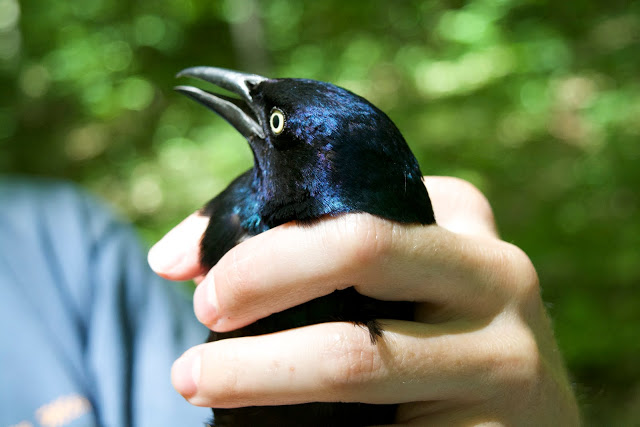
Although I believe strongly in the value of capture/recapture bird banding programs, there is no doubt that the time a bird spends in a mist net and being processed is anxiety producing. Unaware, a bird is moving along with daily activities and “boom” they are caught in a tangle of nylon netting, being handled by an intimidating human. Most species have what we call fight or flight reflexes controlled by advanced aspects of our brain and nervous system. These physiological responses are automatically triggered in response to a perceived threat or attack. As such, most birds like this common grackle I recently pulled out of a mist net are focused only on fighting to get free and flying away.
Fear is a natural instinct. It is common among most species and has an important evolutionary purpose. There is good reason most birds are fearful of a large mammal like myself. Sometimes though, fear is unwarranted, only existing because we don’t understand or know that which we are scared of. Even though I imagine the birds I encounter while mist-netting are fearful of the situation, I’m pretty sure they don’t also develop a much stronger emotion, an emotion far more dangerous than fear – the emotion of contempt. Contempt, it seems, is an emotion reserved almost exclusively to humans and it gets us into all sorts of trouble. It is that feeling that another person, or group of people, are beneath consideration, worthless, or deserving scorn. When fear mixes with contempt, problems emerge, and you don’t have to look far in our world to find the consequences of this collision.
I know enough about history to know that human societies have long dealt with the consequences of fear and contempt of one another. Anyone looking for a recipe for hate only has to add these two components. This is not a new formula. What baffles me though is the fact that it still exists with such fervor today. Haven’t we learned from past mistakes? Aren’t we capable of social learning and progress? Is it really possible for our species to have so much animosity towards our own kind, often times based solely on one aspect of a person’s identity? I’m afraid the answer to all of those questions is yes.
Even still, I turn to the birds. Birds have ample reason to be scared of people. We’ve hunted and exterminated them, destroyed their homes, and altered the climate systems of the planet. I’d even argue they would have a good case for contempt. But over many years now of working with birds, I’ve never once had the sense that they harbor such sentiments.
Their fear is real, no doubt. Once a bird is released from the banding process, it often will fly up to a nearby branch to rest for a few minutes just to gain his/her composure. What the bird almost always does next though is most important. It doesn’t hang around to scorn, or chastise, or judge. It doesn’t stare with disapproval or hatred. It doesn’t concoct a plan to cause pain or suffering for the very object that just created so much fear. It doesn’t have time for those things. Instead, with simple beauty, it decides to fly in another direction and go about the day, releasing the past fear and focusing only on moving forward in his/her journey. There is a lesson in that for us all. I hope our own species begins to take note.
 Wisdom on Wings