I am reminded each time that I get to teach my class on Birds, Ecosystems, and People that binocular use is not an innate skill for the homo sapiens species. Because I know it takes lots of practice to get the hang of the funky little magnifying contraptions, I try to introduce their use early and at a slow pace. Most students can’t even position them against their face correctly when they first start to use them. After a short orientation on the basic parts of the tool and how to properly utilize them, we venture outdoors where I first ask students to target a stationary item like a tree branch or a mushroom. Fortunately, sticks and fungi don’t tend to move nearly as quickly as birds do and learning how to target an object is step number one along the way to binocular mastery. ion
Having successfully oriented a brown mushroom blob into the central field of vision, the next essential task is to tinker with the lens in order to bring the object into focus. This requires the careful maneuvering of two central binocular features – the thumbscrew (or main focus knob) and the individual eye diopters that allow the user to compensate for differences in their vision from one eye to the other. It doesn’t typically take all that long for most students to bring their stationary targets into clear focus – building some initial confidence, all while giving the impression that the process of finding and viewing a bird is just as simple.
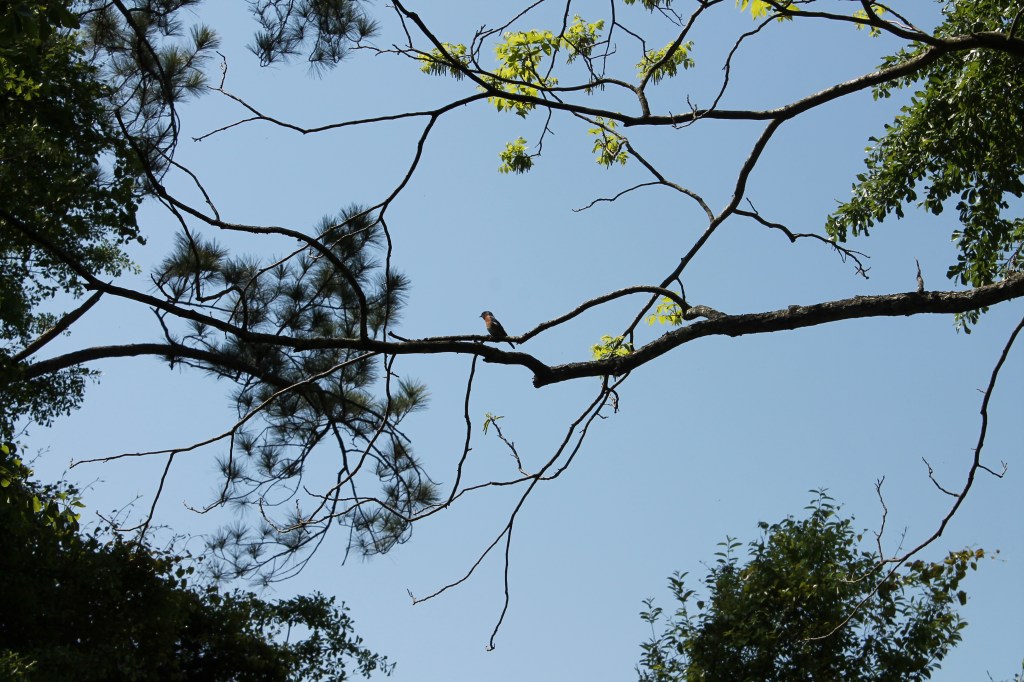
Of course, anyone that has searched for a bird through a pair of binoculars will tell you that it isn’t that easy. For one, most birds don’t sit still – it isn’t in their best interest to do so for long. Food isn’t going to walk right up to a sitting bird, and yet, predators most certainly will. Staying on the move prevents the bird from becoming an easy target and provides more opportunity to complete objectives necessary for survival, tasks like eating, raising young, and avoiding injury.
Further still, moving avian targets aren’t all that interested in snuggling up beside us humans, preferring instead a healthy distance when our bipedal species is in the vicinity. With birds on the move and often far in the distance, birding with binoculars is generally the best bet if you want a clear and crisp picture of the avian form. But birding in complex landscapes like the forests of northwestern PA requires a set of immediate interactions – quick senses that identify hints of avian movement among a mesmerizing background of color and texture, the ability to target and position a bird through dizzying double scopes, fine tuning to get just the right clarity in a matter of seconds, and consistent tracking to keep the bird within your plane of sight. All the while, your avian muse is flittering from one position to another, moving in and out of gradients of light and shifting in front of and behind a maze of objects. Forest birding with binoculars is not for the faint of heart.
As such, it is customary for my students to struggle as they try to learn how to use binoculars to observe and identify birds. Initially, many lack the spatial awareness to capture a bird they can see with their naked eye within the narrow lens of binoculars. Others wrestle with depth perception and the ability to fine-tune the focus knob in alignment with the distance of the target. Some are lucky to catch a quick and clear glimpse of a colorful species, only to lose the bird as soon as it moves ten seconds later. Let’s just say that I’ve grown accustomed to the frequent exasperated noises coming from my students during the first outdoor lab experience with binoculars.
Although my binocular use has improved over time, I can profoundly relate to the frustration demonstrated by my students. What is most vexing in these moments, I believe, is the inability to see with clarity something that is hoped for. Come to think of it, it isn’t just while birding that we desire clear vision and direction. In reality, our lives are filled with searches for the stuff. We want clarity when choosing a career, making big decisions, building friendship, raising children, finding personal meaning and fulfillment, or pursuing a romantic interest. We want to see, without obstruction, the vision and path to reach our goals, satisfy our needs, or satiate our desires. This seems to be a universal yearning.
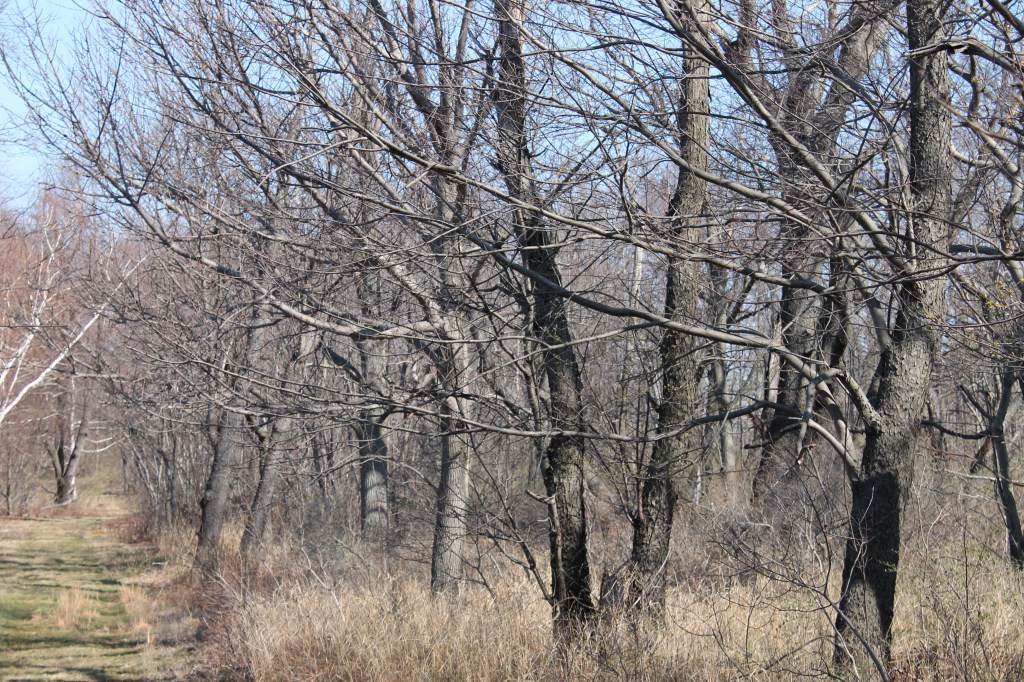
There are times, if you’re lucky, when everything comes into focus – the bird lands right in front of you in perfect light, the stars align to connect you to your soulmate, or a flashing neon sign reads “GO THIS WAY ->”. But having spent more time looking through a blurry and empty binocular lens than I have witnessing the perfectly clear and unobstructed image of a bird, I’ve realized that clarity doesn’t always come easy. Sometimes it doesn’t come at all. Most of the time, if it finally does come, it is only after a significant period of uncertainty, unease, anxiety, and persistent searching. And sometimes, when clearness is elusive, you have to move forward even with a somewhat hazy vision of what might lie ahead. Seeking lucidity isn’t a bad thing, but if we aren’t careful, we can easily become petrified and dejected waiting for that perfectly crisp vision to illuminate the path in front of us.
During the first few weeks of my class on birds, we celebrate those moments when someone captures an impeccable image of a bird in their binoculars. Such flawless accomplishments uplift us all. Perhaps more frequently, however, and while not entirely what we had hoped for, we revel at blurry blobs of color too – for even those represent progress, and life, and hope. Somehow, the practice of embracing the imperfect fuzzy visions that are an inevitable part of our lives helps us muster up the courage to put one timid foot in front of the other in anticipation of those sublime and intermittent moments when the fog finally clears and all comes into focus.
 Wisdom on Wings