When I was young, growing up in North Carolina, the arrival of the Dark-Eyed Junco was a sure sign that winter was on the way. These inconspicuous sparrows breed throughout the high arctic boreal forests during the North American summer and make their way down to more hospitable climates once the fall sets in. They would arrive in the woodlot behind my homeplace about this time (late October) every year. Frequently seen feeding on the ground, the forest floor would come alive when they appeared as they flittered across the newly settled bed of leaf litter in search of the tasty seeds left over from the bumper crop of summer.
Here in northwestern Pennsylvania, Juncos can be seen year-round because it is cool enough for the bird to breed in this climate in the summer. Those that breed here will often head to warmer climates during the winter months when a new crop of the birds will arrive from much higher latitudes. Juncos are arriving even now as I write and will settle in to overwinter by relying on the many types of seeds and berries that adorn the trees and bushes in the region. For a bird no larger than 3-4 inches and weighing only a few ounces, I’ve got a lot of respect for the hardiness of the species to stick around here during our winter season!
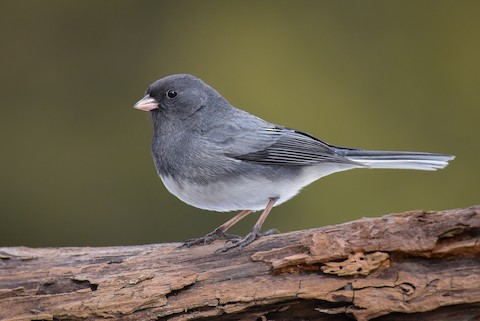
As the small flocks of Juncos have rushed in to frequent my feeders over the past few weeks, I am reminded of the symbolism they hold in my psyche – triggering a flood of feelings of the coming darker, cooler, and stiller days of winter. This year, however, they come as a representation of much more.
When I first arrived in Meadville to begin a position as an Assistant Professor of Environmental Science at Allegheny College in 2014, I was grateful to have three colleagues who are pillars of the department ready and willing to help me transition to a new space and new responsibilities. Remembering that I was a bird enthusiast, one of those pillars, Scott Wissinger, sent me a note in the first couple of weeks I was here, inviting me to join him for a quick trip to see the research reserve owned by the college that he managed.
It wasn’t long before I took him up on that offer and, after a quick drive through the country, we hopped out onto a lightly worn path at Bousson Environmental Research Reserve. No sooner had we started walking when we heard the unassuming, consistent trill of a male Dark-Eyed Junco. Scott quickly flashed a big grin and started to laugh. “I may not be an ornithologist”, he said, “but by golly I could identify that bird anywhere!” After inquiring why he had such an ear for the Junco, Scott began to tell a story about work he had done out west (where he maintained several research projects and partnerships) capturing, banding, and observing Dark-Eyed Juncos. For the first nearly half an hour of our walk, Scott recounted his many hours spent painstakingly identifying Junco after Junco as part of a project that was focused on the physical characteristics of the many sub-species of the bird (Juncos exhibit a surprising amount of geographic variation).
I soon would discover that Scott, a wetland ecologist by training, had a treasure trove of stories and experiences to share about his many years conducting ecological research. But I am convinced that his focus on the Junco during that first walk we took in the woods did not occur by happenstance. Scott had intentionally taken me to this space where he was confident we would encounter a number of birds because he wanted me to feel welcome and at home. He had intentionally focused on the Junco, and his work and experience with the bird, to communicate to me that we shared an interest, that he was excited that I was here, and that it was OK to be my timid, green-behind-the-ears, dorky bird geek self. That was Scott’s way of celebrating who I was – a thoughtful expression of kindness for someone who he knew was likely feeling a bit overwhelmed by the new environment.
Throughout the past five and a half years, I have learned to expect that type of thoughtful kindness from Scott. Never wanting attention or recognition, and never pushy or grandiose in his demeanor, Scott was a work horse behind the scenes – a consistent and reliable colleague who was dedicated to his students, his studies, and his community. He was a sharp intellectual with a warm and caring exterior, most often wrapped in his signature purple fleece! Ever since that very first walk that we shared, I have come to associate him with the Junco friends I see and hear in the woods of northwestern Pennsylvania throughout the year. Juncos around here (the slate colored variety) are not flashy or brightly colored, they don’t perform showy tunes or dance routines, and they aren’t easily excited or provoked. Instead, they are unassuming and sure-footed, a hardy and resilient species, at home in both the deep forest and the communal backyard feeder. They are a reliable, consistent, and adaptable species, not at all bothered by a bit of snow or cold weather – an all-around solid bird. And that was Scott too – an all-around solid guy.
We lost Scott suddenly just a few weeks ago but the Juncos that are hopping around my feeder this afternoon are a warm and welcome reminder that his kindness and his legacy is still here – in the Junco, in the forest, and in the sense of stillness and beauty that they bring.
Rest in peace, my friend.
 Wisdom on Wings
I’m glad I’m alone in my office reading this. Crying. As beautiful and sleek and neatly presented as any Junco standing proudly in sunny patch of fresh snow.
e
LikeLike
We happily await the arrival of our Juncos each year. The last departing hummingbird signals their return and, then, it won’t be long until the first snow and the adorable sight of “The Junco Hop” under the feeders. I’m glad you could share a space of time with your friend Scott.
LikeLike