I just recently listened to a podcast (listen here to episodes 13 & 14) where my good friend and naturalist extraordinaire Josh Arrants (find him here) spoke about his enthusiasm and passion for the natural world. With the energy of a young child, Josh explains his awe of the “magic of nature”. For Josh, as it is for me, there is no shortage of absolute wonder and enchantment anytime you find yourself outdoors.
Just this morning, in fact, I had a chance encounter with a flock of Canada geese flying overhead, perhaps already beginning their migratory journey as the dog days of summer come to an end. Animal migrations of any sort are fascinating and mysterious but the long and arduous journeys undertaken by birds of all shapes and sizes in early autumn are some of the most wonderous aspects of fall.
You may have noticed the preparatory behavior of many of the birds in your area as they ready for their fall migratory journeys. Ethologists call the sort of anxious, sometimes restless behavior zugunruhe, a word with German roots combining zug (move or migrate) with unruhe (anxiety or restlessness). If you watch closely, you’ll notice an uptick in energy, movement, and flight among the migratory birds that have spent their summers raising young in more temperate climates. It is as if they feel the magic in the air and fill with anxious excitement for the demanding journey ahead.
For many migrating bird species, as well as those resident species that will find ways to brave the cooler months in the northern hemisphere, social cooperation is part and parcel to survival. Let’s take a look at three specific examples.
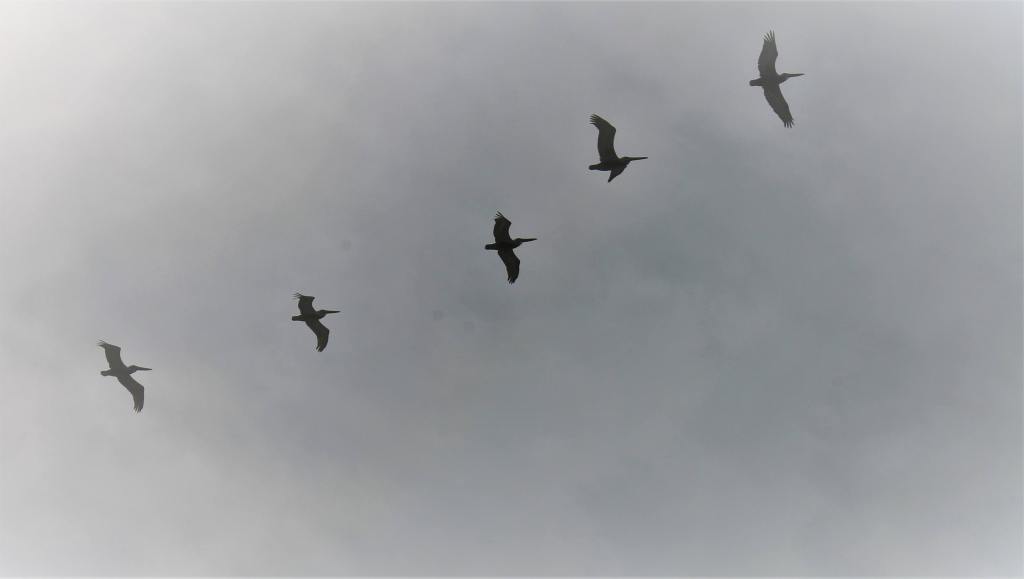
Like many flocks of waterbirds in the family Anatidae, geese are often seen flying in a V formation. As you may know, the value of this flight pattern is in the “air wake” created by each bird as they fly. For any bird lucky enough to be flying behind another, they get a little boost from this wake, which reduces the amount of energy needed during what can sometimes be a lengthy journey. What ecologists have now discovered, however, is that it isn’t just luck behind such cooperation. Rather, it is a coordinated and purposefully egalitarian system that involves a constant rotation of individuals within the formation. Because the goose at the front of the V does more work than the others (with no wake benefit from a bird in front), all members of the formation cycle into and out of that position over the course of the flight. Each member is expected to serve a stint in the most uncomfortable position of the group, even when it goes against it’s own best interest.
Of course when geese form V formations, you typically don’t see more than a dozen or so birds in one group. For other species like starlings, shorebirds, and blackbirds, when they move in groups their numbers can be in the thousands! You’ve probably seen the incredible videos of starling murmurations that are as much mesmerizing as they are scientific marvel. Although the value of the rapid group movements are clear – the ability to confuse and evade predators – the capacity of each individual bird to work in such synchrony has long baffled scientists. Early observers of the phenomenon hypothesized that the birds use some form of telepathy, or that a deeper connection existed some described as a “group soul”. Recent research using computer programing and modeling is beginning to unravel the mystery. For a murmuration to function, each member has to avoid colliding with it’s neighbors and move in the same direction as the rest of the group. Although there is still much to uncover, we now know that these aerial acrobatics rely on each individual bird tracking the split-second movements of not just one, but seven of their closest neighbors! Informed by what Wayne Potts has called the “chorus line hypothesis”, every member of the group has to be aware of and responsive to the behaviors and interests of those nearby. Otherwise, the whole system would collapse.
As one final example, now that summer is beginning to wane and the nights will soon turn cool across the eastern U.S., many bird species take advantage of what is called social huddling. In my neck of the woods, species like the Carolina chickadee, eastern bluebird, and Carolina wren are known to gather in small groups at night (often in protected areas like tree cavities) to huddle together and keep each other warm. Birds across the globe demonstrate this cooperative survival strategy. This research on emperor penguins has revealed that these social huddles are not random and disorganized processes, but rely on social norms, structures, and coordinated movements so that each member of the huddle has sufficient time inside while also “paying their dues” on the outside. I suspect it isn’t fun to be on the outside of a huddle in -30 degree temperatures, even for a penguin. But when social cooperation is essential for survival, every member has to “take one for the team”.
When you stop and think about it, the sort of social integration and cooperation we see in birds makes a lot of sense from an evolutionary perspective. There are obvious benefits as highlighted above. Unless you are a top predator, are not threatened by one because of your size or defense mechanisms, or benefit from some sort of asexual reproduction, being single is almost always more risky in the natural world. Even among those species that live parts of their lives in solitude, cooperation is still necessary to achieve the essential tasks that perpetuate and sustain life.
Isn’t it odd then that we humans seem to have a harder and harder time realizing this basic fact of life???
For far too many humans in my own country, a preoccupation with freedom and individual rights and liberties has all but erased a sense of common purpose, sacrifice, and duty to act in a way that supports the good of the whole. After all, as a nation, society, and world, we are the sum of all of our individual parts. If we don’t pay attention to that sum – that is our collective connections, interests, and future – then we will ALL fail eventually. That isn’t to say that we shouldn’t appreciate and celebrate individual liberty and freedom, but not without also acknowledging that we are not islands unto ourselves. Humans, like most species, have never functioned as individual or independent organismal units. We have always depended on collective action and cooperation for survival. The need for social interaction and cooperation is quite literally baked into the wiring of our brains and laws of social dynamics.
Because of this, our very survival depends on the ability to exhibit behavior that does not necessarily serve our own self-interest – but the greater, larger collective interest. Compromise, therefore, becomes one of the fundamental components of functioning social groups of organisms. This is true for us just as much as it is true for geese, starlings, and penguins. Such cooperation also makes for a more kind, compassionate world, one where you can trust that folks are interested in the wellbeing of more than just themselves.
I appreciate and realize the value of liberty and freedom. I am not an advocate for systems that repress or deny basic rights and liberties of individuals. In fact, I believe that all creatures should have basic rights that ensure freedom from certain ills and opportunities for certain joys (it is why, for example, I have long been an animal welfare advocate). However, individual freedom is only possible in a functioning society based on certain collective ideas, principles, and rules of behavior. Compromise and collaboration are therefore necessary prerequisites for freedom and liberty. I worry that far too many people today neglect to see this dynamic and intertwined relationship.
As the United States is currently embroiled in an unnecessary battle about public health and individual freedom, my skin crawls when I hear people talk about their individual rights in a way that supposes those rights supersede any obligation or responsibility for the welfare and wellbeing of others. They don’t. Period. Our entire social system would collapse if that were the case. Every person for him or herself never ends well for the human or non-human animal alike. Just ask the penguin who decides to break from the huddle when it is -30.
I recognize that individual freedom as paramount dogma is alluring because it relies on a fantasy world in which we all do what we want, whenever we want, in whatever way we want, no matter what impact that has. That sounds great, on the surface, in part, because it absolves us of any responsibility for anything other than ourselves by playing to our more sinister selfish motives. Such a fantasy is just that and has no basis in the realities of organisms who exist in complex socio-ecological systems. It isn’t just our survival, but the maintenance of those things that provide the mechanisms for individuals and groups to thrive and prosper that are all linked to the processes of compromise and cooperation.
I often turn to the birds for insight and guidance in times of challenge. Not only do they posses magic, but they possess deep wisdom too. We humans have much to learn from their example.
 Wisdom on Wings