This past winter, a bully invaded my backyard.
By now, those who read my blog know that I love birds. Like, adore them. I generally soften my heart even to the most annoying avian companions, like the non-native European Starlings that gobble up my suet or the House Finches that crowd my feeders. But this bully, well it was just too much even for my patience and goodwill.
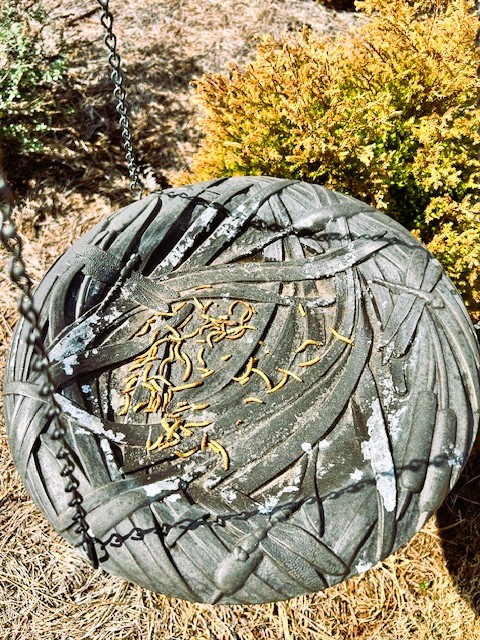
I have a variety of bird feeders in my small backyard that contain different foods to attract as much diversity as possible (sidebar: both in nature and human society, diverse communities tend to be the healthiest, most productive, and the most resilient). For the Eastern Bluebirds and other invertebrate-eating species, I put out dried mealworms a couple of times a day. I typically have a pair of Bluebirds that nest in my backyard in the spring, and it is always fun to watch them raise a new clutch (or two!) of young ones during the summer. Because the Bluebirds in my area stick around throughout the fall and winter, I keep the mealworms coming all year long.
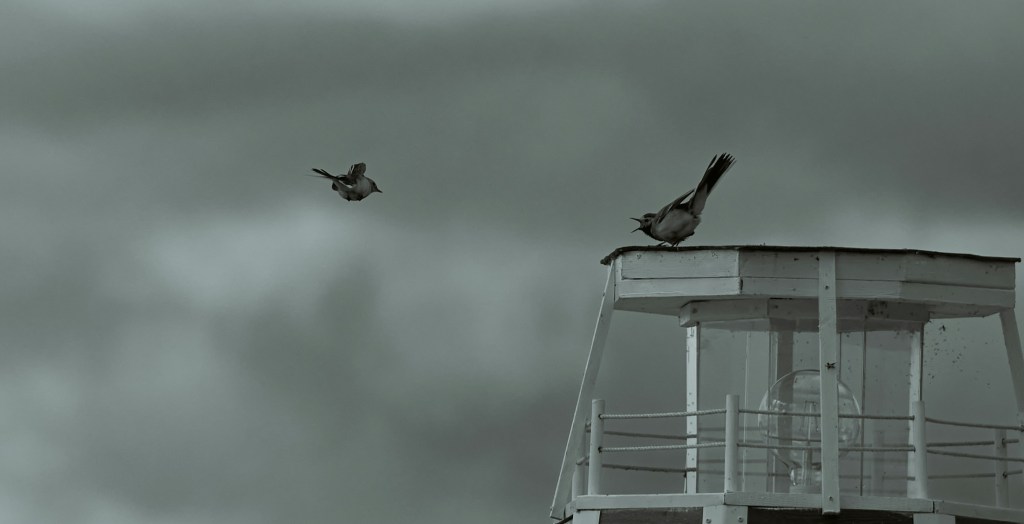
As the weather turned colder last October, a Northern Mockingbird began frequenting my yard. At first, this wasn’t unusual, as I see them hop in and out throughout the year. But this bird started staying longer and quickly became territorial. I have a couple of native fruit-bearing trees (hawthorn and winter berry) in the back and I’ve since learned that Mockingbirds will sometimes guard a winter food source with surprising intensity. But this particular bird took it to another level entirely. It would perch at the highest tree to surveil the entire yard. As soon as another bird even approached the mealworms, it would swoop down and attack. It seemed indifferent to the birds that ate only seeds, but it was especially aggressive toward the Bluebirds. It even targeted the Mourning Doves, though they don’t eat mealworms or berries, which remains a mystery to me.

My Bluebird friends tried to sneak in when the Mockingbird was off in a nearby field, but it would bolt back the moment it noticed. There were plenty of mealworms to share, but the Mockingbird’s hoarding instincts overrode any opportunity for coexistence. I tried everything—noises to deter it, chasing it off myself, even setting up a second mealworm feeder to “share the love.” Nothing worked. Even my well-meaning neighbors suggested more drastic measures (which, for the record, would violate the Migratory Bird Treaty Act). I didn’t want to harm the bird—I just wanted it to play nice and share!
Finally, after several months, the Mockingbird found a new home.
Looking back, I realize that, for the Mockingbird, this behavior was about survival. In a cold, harsh world, it perceived food as a limited resource, something to be guarded at all costs. For birds, this is all too real in the frigid winter when food is in short supply. In that light, my label of “bully” might be too simplistic. After all, birds have a limited view of the world, one framed by their immediate and individual needs and existence. But nature also teaches us that an “every bird for itself” approach isn’t always the best strategy.
While the Mockingbird’s instincts led it to hoard resources, many species take a different approach—one that benefits not just individuals but entire communities. African wild dogs, for example, rely on coordinated teamwork to hunt prey successfully. Clownfish and anemones have a mutually beneficial relationship—clownfish gain protection, and the anemone gets cleaned of parasites. Even among birds, research shows that cooperative breeding (where non-parent birds help raise young, sometimes even in non-kin groups) can improve survival rates, especially in challenging environments.
Humans are no different. The ability of our species to cooperate and form social networks is one of the key reasons we have thrived over thousands of years. And, because we do know better – that we can all survive if we don’t take more than what we individually need – those who suggest otherwise, well, they may be more focused on greed than anything else.
What’s more, psychological research has shown that human bullies that propagate such a “me-first” approach—whether in a schoolyard or positions of political power—often experience higher levels of loneliness, dissatisfaction, and insecurity than those with more cooperative worldviews. Studies suggest that aggressive, dominance-driven behaviors in humans can stem from low levels of self-esteem and empathy or elevated levels of anxiety, depression, or anger. While their external actions may project confidence, their wellbeing, and the wellbeing of those that surround them, is often eroded by their own behavior.
If you’ve been following the news lately, from the local to the global, there are endless stories of bully-like behaviors that disregard cooperation, generosity, and compassion. Just like my backyard visitor, there are those in the human world who mistake control for security, who hoard power at the expense of others, and who disregard the collective good for the benefit of a few. But nature—and history—teach us that this is a short-sighted strategy.
Bullies try to push others around, intimidate, and instill fear to maintain their dominance, often disregarding the well-being of both people and the natural world. But ultimately, those who find ways to cooperate, to build alliances, and to work toward shared goals are the ones who endure and thrive. The strongest communities—human and ecological—are those that recognize interdependence, valuing the needs of all creatures, not just the most powerful.
My recent experience suggests that when dealing with a bully, the best solution is to find ways to cooperate with others to outwit or outlast selfish and unproductive behavior. The self-serving approach simply isn’t sustainable in the interconnected and interdependent world we live in. Nature teaches us that cooperation, generosity, and resilience win in the end. And so, in this moment, we have a choice: to respond to selfishness with more vanity, or to build something stronger—together, in community.
 Wisdom on Wings
Very good ideas and well written.
Dad
LikeLiked by 1 person
Fortunately I stumbled upon your post in LinkedIn so I realized that your posted had ended up in my Spam folder. So grateful to have discovered this, because your writing inspires me. I am very glad you are part of my community during these horrible times.
LikeLike