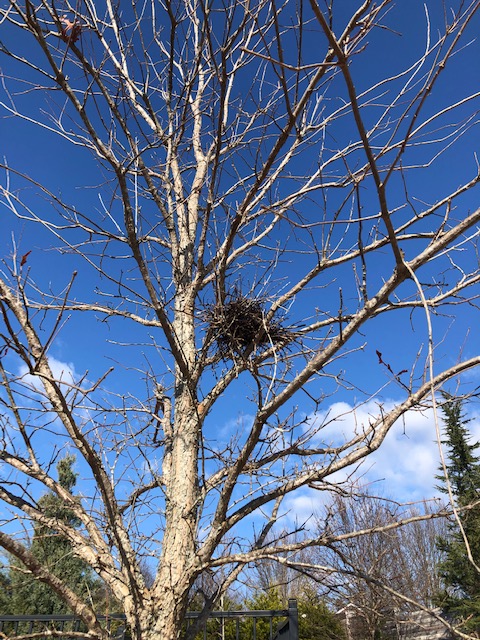
If you’ve ever searched for a bird nest in the summer months, you know it isn’t an easy task. I have been a part of several research projects designed to monitor nest predation and success (how many hatchlings actually survive to fledge) that required our research team to locate as many nests as possible within a defined geographic region. By far, the most difficult part of a project of this nature is searching and finding the temporary incubation chambers constructed by our avian friends, especially because nest predation studies must occur during the breeding season, when trees, shrubs, and groundcover are filled with the perfect concealer of nests – large quantities of leaves! I once supervised a student research project on grassland sparrows that required me to accompany my student colleague for hours, and sometimes days, searching among tall grasses just to locate one, perfectly hidden nest!
It is, of course, in a bird’s best interest to construct a nest as conspicuously as possible. Predation is, without a doubt, the greatest cause of nest failure for songbirds. A recent study documented over 90 different nest predators for North American songbirds, including rodents, snakes, mammals, insects, and other birds. Rates of nest predation appear to be on the rise as well, due, in part, to more human development and disturbance encroaching on traditional nesting habitat, allowing easy access to more types and greater numbers of predator species.
Accordingly, birds pull out every trick imaginable when deciding on a place to locate and build their nests (I recommend this book if you’d like to know more about avian architecture). Strategies include the use of materials that blend in with the surrounding environment as camouflage, constructing within dense vegetation or debris, positioning the nest in high areas that are harder to reach, and sometimes taking advantage of predator deterrents like humans (wrens and swallows, for example, will build nests in the eaves of human structures as these areas are visited less by predator species). If you’ve ever been lucky enough to stumble on an active nest during the breeding season, I suspect you’ve seen just how clever our bird-brained neighbors are when it comes to covert nest assembly.
And so it is to my delight when, following the dispensation of leaves in the fall, the veil is lifted on the hidden avian nurseries that our forests, backyards, and road-side thickets contain. Anyone who knows me can attest that I am not a fan of the cooler months of the year. Even still, one of the aspects I’ve come to appreciate about this time of year is how easy it is to locate abandoned nests.
If you get an opportunity to inspect a nest in the non-breeding season (please do keep your distance if the nest is active during the breeding season), I hope you’ll take a close look. You will likely notice that the structure is beginning to fall apart. That’s because nests aren’t usually designed for more than one-time use. That’s right – despite how amazing birds are, when it comes to nest building, most birds think in the short-term. In fact, there are very few species (raptors among them) that utilize the same nests more than one breeding cycle. If you think about it, this makes sense, given the size and scale of some raptor nests (take a look at a Bald Eagle nest if you ever get the chance). It is more time- and energy-efficient to invest in long-term construction when the nest required is of a considerable size.

For a bird that may only live 4 to 5 years, however, it doesn’t make sense to invest so much effort, energy, time, and resources into a structure that is only needed for a short incubation period of 2-4 weeks each year. Even birds who often have multiple broods in one year very rarely use the same nest for consecutive broods.
As I’ve recently explored the abandoned nests of my neck of the woods in Greenville, SC, I’ve been intrigued by the short-term nature of these structures. Many of them have lost all structural integrity after just a few months. Others are hardly recognizable. My nest hunting adventures have sparked broader reflections on the all-too-frequent short-term behaviors employed by our own species. Although birds have good reason for such an approach. I’m not convinced that humans are justified in employing similar tactics.
I recently listened to a Hidden Brain podcast with psychologist Paul Slovic on the way our brains process risk. It turns out that, evolutionarily, the human brain evolved to think in the short-term, for the most part, and doesn’t instinctively process long-term risk well. We have to turn to neuroscience to understand why this is the case. What I understand from my colleagues who study the brain (disclaimer – I am not a neuroscientist) is that there are three primary areas of the brain – our brain stem, which controls basic motor function, our limbic or emotional brain, and our neo-cortex, or rational thinking brain.
The limbic system in the brain is millions of years older than the neo-cortex. It has played an important role in ensuring the survival of our species with quick, more primitive instinct-based decisions designed to keep our ancestors out of danger, with full bellies, successful offspring, and, more generally, without being eaten! This system served our ancestors well, but primarily relies on short-term, consumptive, and reactive behavior. To be clear, the limbic system is vital, and plays an important role in our daily lives.
The neo-cortex, on the other hand, developed in our species much more recently and allows for more rational long-term strategic planning and foresight, although it has also opened up opportunities for sinister aims like manipulation and the coordination of violence against others. We are not the only species with these abilities, as animal behavior research is now revealing, but we are among a small handful that have advanced rational capabilities. The way I see it, that distinction comes with great responsibility to actually use those functions in service to the sustainability of our species, other species, and the planet.
Unfortunately, if you look around us today, it is clear that our species hasn’t utilized that cognitive capacity wisely. The evidence of short-term thinking and decision-making is ubiquitous. Consumer products designed to degrade and fall apart for quick profit (it’s called planned obsolescence), the exploitation of vulnerable populations for rapid economic gain (for a modern day example look no further than the exploitation of the Uighurs), rapid infrastructure construction that isn’t designed to last, and the destruction of entire ecosystems for a quick and short-lived productive boom reliant on the total utilization (and depletion) of the underlying natural system (palm oil is but one example). We see evidence in our political systems as well. Look no further than the recent energy debacle in Texas to see the consequences of short-term, unregulated systems designed for cheap and immediate gratification.
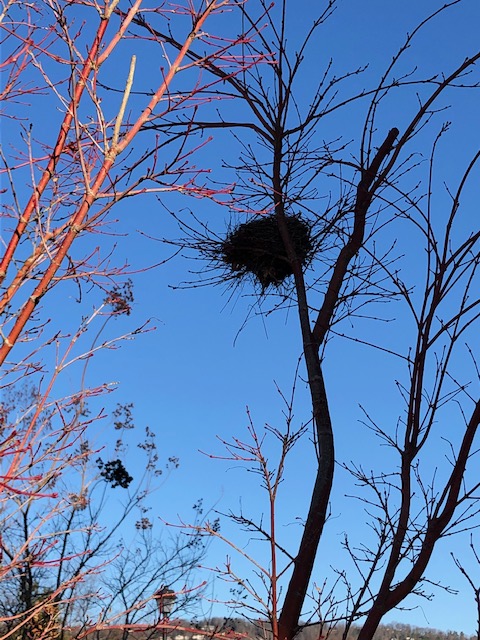
The short-term nest building of birds has little consequence for the rest of the planet. In fact, because most nesting material is organic in nature, these structures will eventually be recycled into all sorts of other natural chains and cycles. For our species, on the other hand, regular short-term thinking has enormous consequences, both for us, and for the planet we depend on for survival.
The dilapidated nests I encounter this time of year on my daily jaunts outdoors have now taken on new meaning. They are symbols of the rapid deterioration that we can expect from short-term decision-making. And yet, I need not look any further than the sturdy trees in which many of these structures are precariously perched for evidence that long-term investments have the potential to cultivate lasting and elaborate joy and beauty. With a bit of care, those steadfast branches will yield rich blooms, fragrances, fruit, and color for decades to come.
 Wisdom on Wings
I have found myself longing for a new installment of Wisdom on Wings. Thank you for obliging. Maybe the lesson of nests is to construct our homes with nature in mind, recognizing that there is no waste. Even an abandoned home is nourishment for ecosystems. Missing you a ton, my dear friend.
LikeLike
Yes, Eric! There is much in avian architecture we can learn from. The most obvious, of course, is the design of modern airplanes (modeled off of the shape and function of bird wings/anatomy) but there are even greater lessons to learn as you point out here. Zero waste seems to be a good place to start. Miss you as well!
LikeLike