Not long after moving to Greenville, SC I joined the Greenville County Bird Club. Although I have a variety of interests and hobbies, finding fellow bird enthusiasts was high on my list upon my arrival. In addition to regular outings and excursions, the club hosts a listserv where members can communicate about all things bird. One of the features I most appreciate about this benefit is the frequent missives from fellow members sharing their joy at the arrival of spring migrants in the first few months of the year. Just last week a jubilant notice went out noting a FOS (first of season) Purple Martin (Progne subis)!
The largest North American species of the swallow family, the Purple Martin is a talented aerial insectivore. On the east coast, these birds most often nest in man-made homes assembled in colonies (or neighborhoods), while they more regularly utilize old-fashioned woodpecker holes on the western side of the continent. Purple Martin landlords (a common term for those that maintain artificial colonies) are fiercely dedicated to the species and will adapt their lives (and the landscapes around their homes) to appropriately attract the birds each spring and provide them with an environment most likely to lead to breeding success. For those bitten by the Purple Martin bug, there is no greater satisfaction than seeing the FOS scouts arrive on property in early spring. As long-distance migrants, many Purple Martins breed as far north as New York, only to congregate every fall, often in large pre-migratory flocks, before traveling to overwinter in South America.
There are many birds like the Purple Martin that live a life of vast travel and adventure. Despite their intrepid nature, however, these birds are keenly in tune with their environment. In fact, the synched timing between natural systems and the annual cycles and behavior of most migratory birds is essential for survival. Most migratory species have an innate ability to sense when it is time to journey north in the spring, or south in the fall. Changes in body chemistry are triggered by reliable indicators within the circannual rhythm of the earth. Shifts in the photoperiod (the length and timing of daylight) frequently trigger hormonal changes in migratory species that guide their decisions about migration timing. These physiological changes allow birds to “trust their gut” when it comes to initiating long-distance travel instead of relying on much more unpredictable or unstable indicators like weather or the seasonal availability of resources. Such synchrony with the natural world has evolved over centuries so that key moments in the lifecycle of each unique species align with the resources needed to support that period. With Purple Martins, for example, their internal clocks are calibrated so that they migrate and arrive on their breeding grounds right at the peak of an insect explosion so that they might have enough food to feed their young.
The Purple Martins that arrived in my neighborhood last week remind me that timing makes such a significant difference, both for the lives of Martins and for people too. In my nearly forty years of life, I have come to understand this more with each passing year. There was the job I really wanted at an institution that laid off much of their workforce only a year later. Or the graduate advisor that so perfectly aligned with my interests who had been hired just months before I applied to the program. Or the person I was convinced I was supposed to marry turning out to be the dear friend I needed much more instead. Most recently, I bought a house just in the nick of time because rapid changes in interest rates and inflation of late may have shut me out completely now just a few months later. The truth is – I have simply lost count of all the times when timing played an essential role in an ultimate outcome. Sometimes in life the stars align with shimmering synchrony. Yet it is also possible those same stars reach the end of their journey – fizzling out in the distance. The constant companion of time is both beautiful and cruel all at once.
To further complicate matters, the timing of life is a distinctly personal affair. The right time for you might be totally wrong for me. I have a good friend who is most productive around ten o’clock at night whereas my brain shuts down after about 3 in the afternoon. A cousin of mine married in her early 20s. There was no way I was ready for anything close to marriage at that age. And most shocking of all – I know whole families who like to open Christmas gifts on Christmas Eve instead of Christmas morning – pure sacrilege in my own family! It is said that timing is everything, but invariable it is not. It is up to each of us to discern how best to navigate the temporal dimension of our lives. Despite what popular culture might tell us, there is no universal blueprint.
Having learned the hard way, I know the trouble that can arise when you follow someone else’s expectations about the “right” time for something. Instead, it takes careful observation and introspection to arrive at a clear understanding about whether it is your right time for (fill in the blank here). External indicators from other directions (whether they be people or otherwise) might help inform decisions about timing, but they shouldn’t be the sole driver of those determinations. Even the gregarious Purple Martin, traversing the gulf coast along with thousands of other comrades each spring and fall, finds her own distinctive path at her own exclusive time. “The bad news is time flies”, said Michael Altshuler, “the good news is you’re the pilot.”
Although I believe strongly that we must set a timetable for our lives that is our own, migratory birds provide an equally important yet vexing lesson about the temporal dimension of our existence – there is no such thing as perfect timing. If the Purple Martins now landing in backyards across the southeast U.S. waited for the perfect conditions to migrate, they would still be in the verdant forests of South America today, waiting for that perfect moment to catch the wind. Although weather can influence the precise timing of a migration journey, the truth is, once a Martin decides it is time to leave, they leave. Sometimes in rain, sometimes with a bit of a headwind, but when they sense the time has come, these purple beauties trust their instinct and fly.
That’s another one of those valuable truths I wish I would have learned a little earlier in life. Perfect timing is a fantasy. As if there ever really is the perfect time to complete that major home renovation? Or schedule the elective surgery, or decide to have children? I know very few people who would argue that the perfect time for any of those activities even exists. From my vantage point, when you feel an inner tug, listen and have patience with that voice, and make adequate preparations for action, that’s about as perfect as it’s going to get! As corporate strategist Bernard Clive has said, “if you keep waiting for the ideal time, chances are there will never be.”
In a very real sense, Martins provide a warning to us humans about the dangers of an inflexible approach to time. Over the past several decades, Purple Martin numbers have dramatically declined, in part because of a growing mismatch between spring arrival times and peak insect availability. As our climate changes and spring comes earlier than before, insect reproduction, which is typically triggered by weather, and not an internal clock, is happening earlier and earlier. All the while, Purple Martins are arriving to breed as they have for centuries – finding too few insects available to feed their growing young. Recent studies suggest that declines of long-distance migratory birds may be a result, in part, of endogenous, relatively inflexible departure schedules from wintering sites in the tropics (in biological speak – low phenotypic plasticity). In other words, with migration departure times internally programmed, the birds can’t easily adjust as the climate around them changes. It will likely take decades for these birds to evolve an adaptive response to a warming world. But species like the Purple Martin are declining at such a fast pace that such an adaptive response may be too slow and too late. A survival strategy woven into the genetic fabric of this species to help them navigate the tricky business of time has now become a liability due to human induced climate change. It is a warning to us on multiple fronts, but especially one that asks us to heed the dangers of rigid adherence to a fixed schedule. Perhaps veering off course, flying in a direction previously unimagined, isn’t such a bad thing after all.
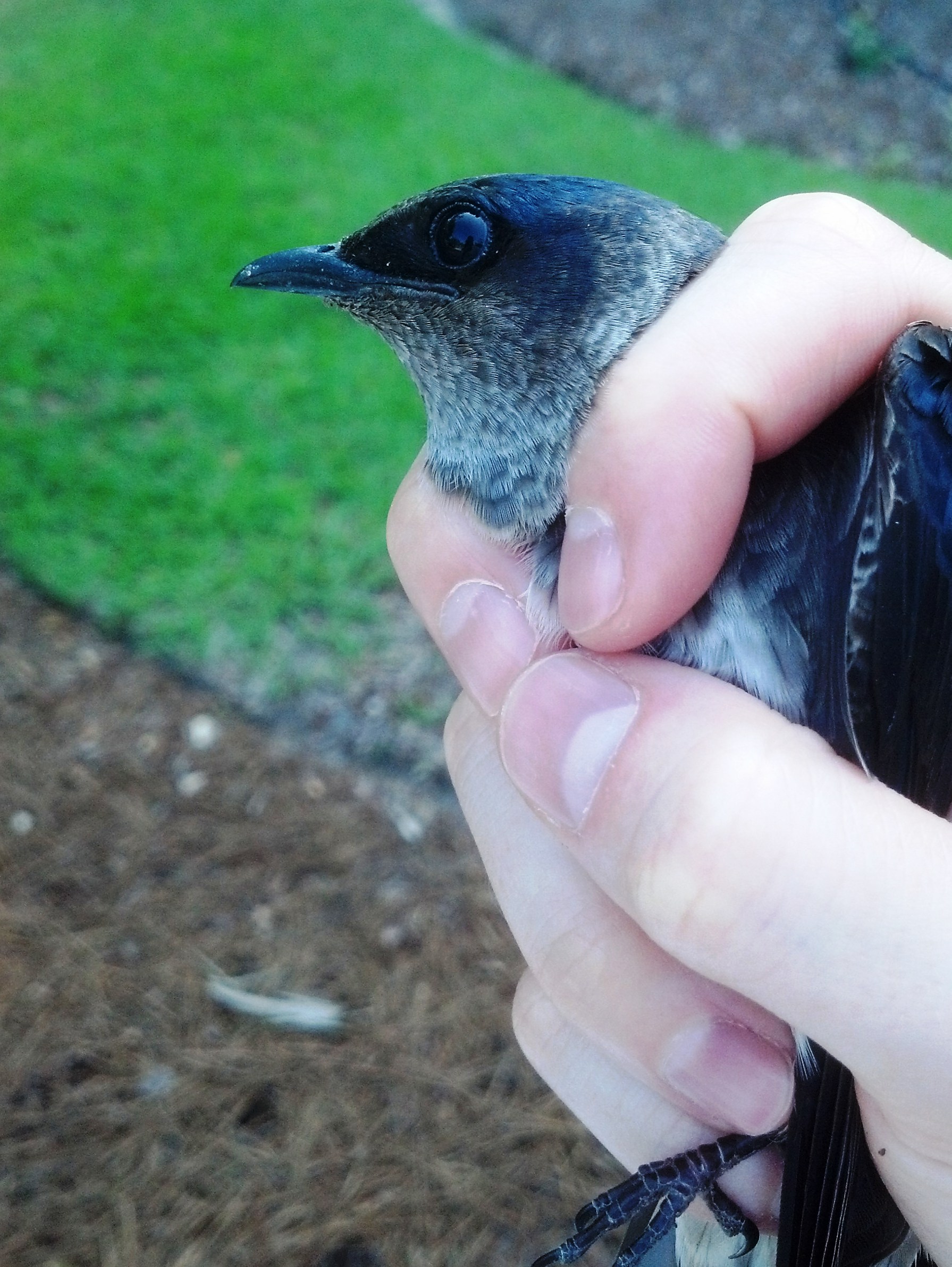
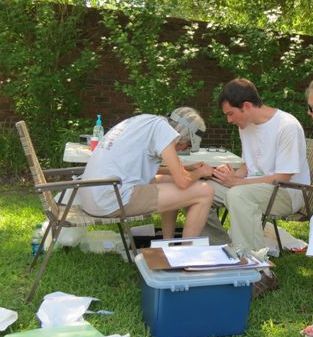
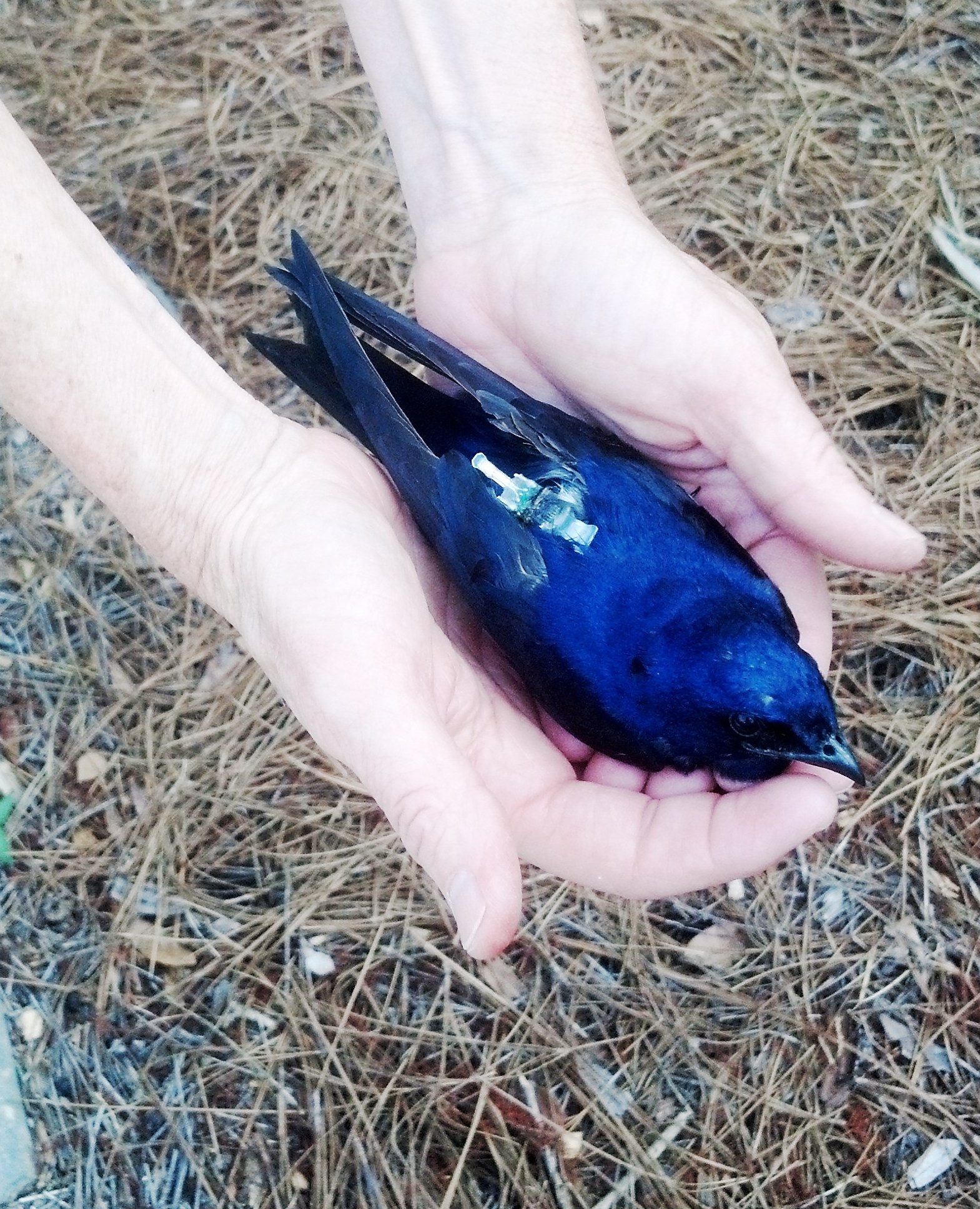
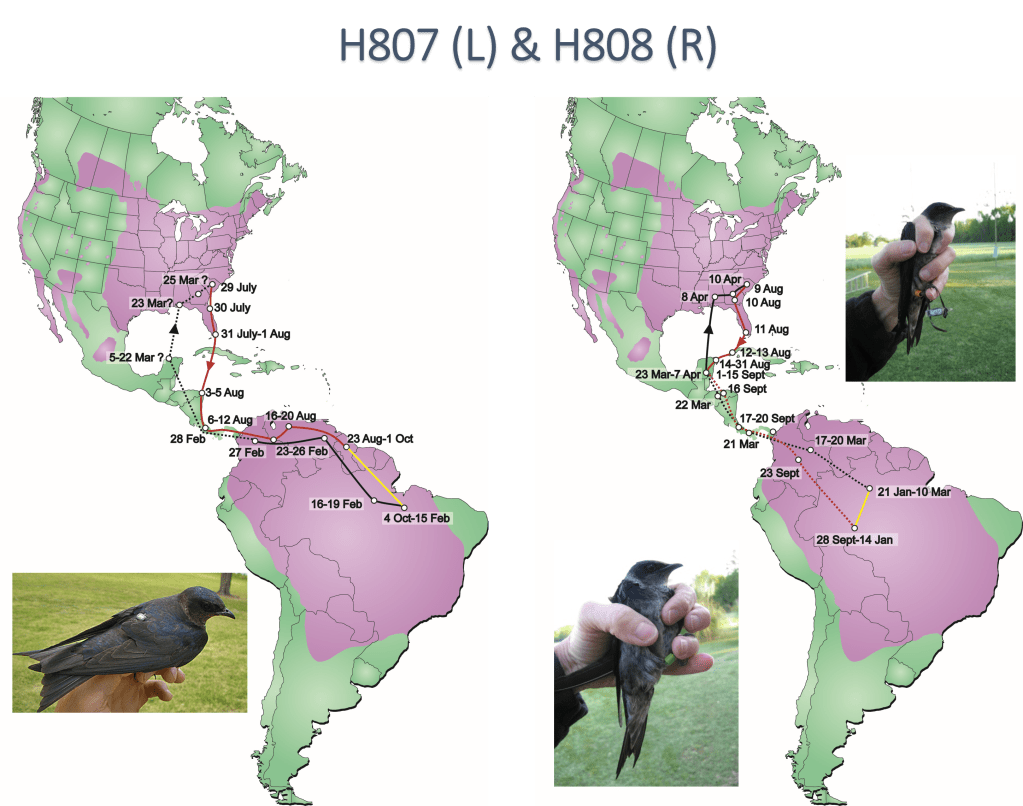
Playing just a small role in the much bigger research project that informed the publication linked above (see here), I collaborated with a colleague to fit several Purple Martins with tiny geolocator backpacks so that we could track their annual migration in 2012. Pictured here are two birds that participated in the study (see maps of their migratory journeys above).
And so it is that the Purple Martin provides us with a plate full of food for thought. The FOS arrivals admonish us to trust our inner guide when it comes to timing those important life decisions, caution us not to open or close doors alone based on the cues of others, but also warn not to wait around for perfect conditions either. I don’t know about you but I am still learning to trust my internal compass and stay focused on the map of my life and not the blueprints of others. To be honest, it is much easier to go where the tailwinds of those around me flow. And while I trust my inner navigation more than ever before, I have seen the danger in sticking too closely to a predetermined map in my own life too. The world is changing fast. Tomorrow is guaranteed to be different than today. If I am going to successfully navigate a path with meaning and purpose, I must be open to routes previously unimagined or off limits, to an altogether new time and schedule. As Hans Christian Anderson once said, “enjoy life for there is plenty of time to be dead.”


It’s so good to have your FOS post. I’ve missed these posts. You speak to me.
LikeLike