In an increasingly complex, fractured, and information-saturated world, it is a rare occasion when any one event commands the attention of so many people at once. And yet, just this past week, the passing of the Queen of the United Kingdom, Her Majesty The Queen Elizabeth II, marks such an occasion. Some have suggested that the Queen was perhaps the most, if not one of the most, notable and recognizable people in the world. Even at the age of 96, the news of her somewhat unexpected death reverberated across a wide range of communitues, countries, and continents.

As political and historical commentators have noted, the death of the United Kingdom’s longest serving monarch is a watershed moment, one that signifies the end of an era at a time of significant national and global change. Change, of course, for a 96-year-old sovereign like the Queen, was something she was all-too-familiar with. Since her ascension to the throne in 1952 at the age of 25, entire social, economic, political, and environmental revolutions have occurred. Technology alone has radically transformed our lives (the Queen herself was the first monarch to rule in the age of television) and multiple cultural traditions, beliefs, and institutions have shifted dramatically. Queen Elizabeth II presided over a major evolution of the very role of the monarch – shaping a new, more modern, more unifying institution of constitutional monarchy – perhaps one of the primary reasons it still exists today.
Yet despite all of this change, one of the most impressive and remarkable characteristics of the Queen was her consistency and steadfastness. In part because of her seven decades on the throne, she has been an anchor and constant in a vast and tempestuous sea of change – not just for the Commonwealth, but for the world. In reading some of the recent commemorations of her life by those who knew her best, I have been struck by her many enduring qualities – her love of nature and animals, her dry and witty sense of humor (I love this recent clip with her and Paddington Bear), her down-to-earth persona, and her abiding sense of religious and civic duty.
I have been lucky enough to witness the same kind of endurance in the face of change play out in real-time in my own backyard this summer. On one early spring afternoon in early May, a young family of Eastern Bluebirds first appeared at one of my bird baths. Two doting parents were eagerly followed by three young fledglings, which, based on their appearance, were but a few days out of the nest. At first, the young birds only watched their parents at the bird bath, fearful of the strange liquid goo it contained. But after several days with the parents patiently demonstrating how to drink from the bath and splash around in the water, the youngsters slowly inched closer to the newfound device – at first underneath it and then by perching precariously on its edge. One afternoon, as I watched from inside my home, one of the juveniles decided to give this bath thing a try. Moving just to the edge of the water, the young bird dipped its wing into the water, gave a quick and full-bodied shake, and promptly jumped out!
To my delight, this family of birds started visiting my baths each day, usually several times. I watched with anticipation as the three juveniles got braver over time, gradually becoming more comfortable with the water, learning how to maneuver in and out of the bath, and finally perfecting the chaotic art of bird bathing. During the hottest days of summer, the three youngsters would arrive early in the morning to perch underneath one of my reading chairs or along the side of my fence to enjoy a bit of shade and escape the scorching sun. Their parents would leave them there for several hours – safe and sound in my backyard avian daycare. In the early evenings, the eager parents would return, quickly check on their progeny, and coax the little ones out into my yard for lessons on insect hunting!

Grateful for their daily visits, I found much joy watching these little ones grow up. Not long after they arrived, I began to notice nuances among them – slight differences in their appearance and behavior. So that I could distinguish among them, I assigned them names – Larry, Curly, and Moe! Moe was the smallest of the three, usually the most reserved, and yet typically the more curious. Although cautious and timid, Moe would hang around my windows and French doors frequently, peering inside with wonder about the treasures of homo sapien variety within. Curly, on the other hand, was the most active, almost always first to jump in the bird bath when they arrived, and the most dramatic bather by far. I routinely had to bring out more water once Curly was done in the bath as most had been emptied due to particularly grandiose splashing. Finally, Larry was the most easily distracted of the trio and also had the brightest blue tail feathers. After jumping in the bath and taking a momentary dip, something would hop in the grass or fly above and Larry would almost always take off in chase!
As the weeks progressed and I watched the birds grow, the rate of change they displayed was sometimes dizzying. I watched them hone and perfect their flying (and landing!), the movement they needed to drink from the bath successfully, and the routines they employed to clean every feather just right. I witnessed these stooges become less and less dependent on their parents, develop into skilled insect hunters, and grow in confidence as they discovered their voice and song. Now nearly four months since they first arrived, they look and act like different birds, even as they continue to pay me daily visits. And although all three of these young birds changed dramatically over the summer months, they each remained very much the same as well. Moe stills pecks at my window, Curly still empties my bird bath, and Larry still chases every moving blade of grass…
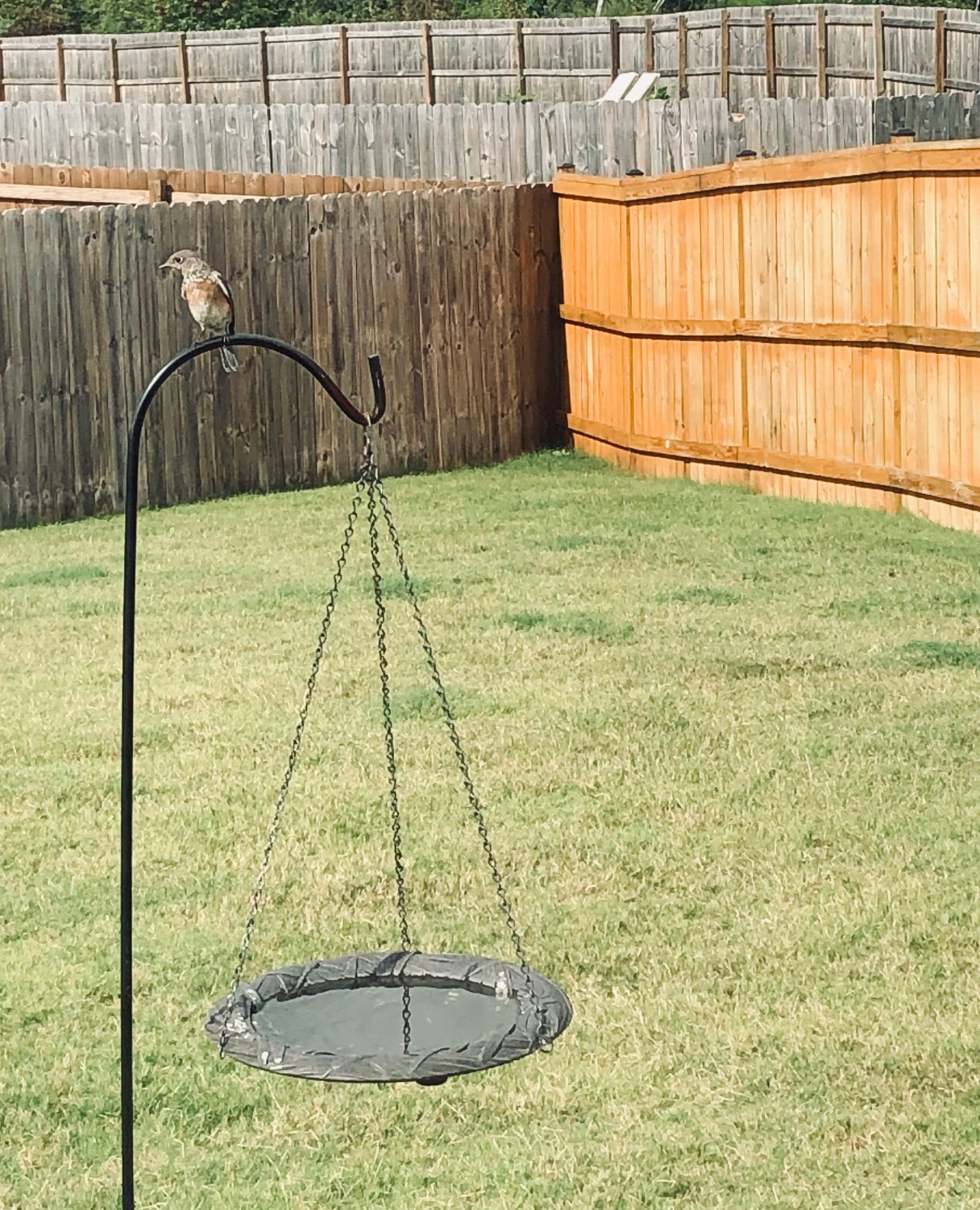
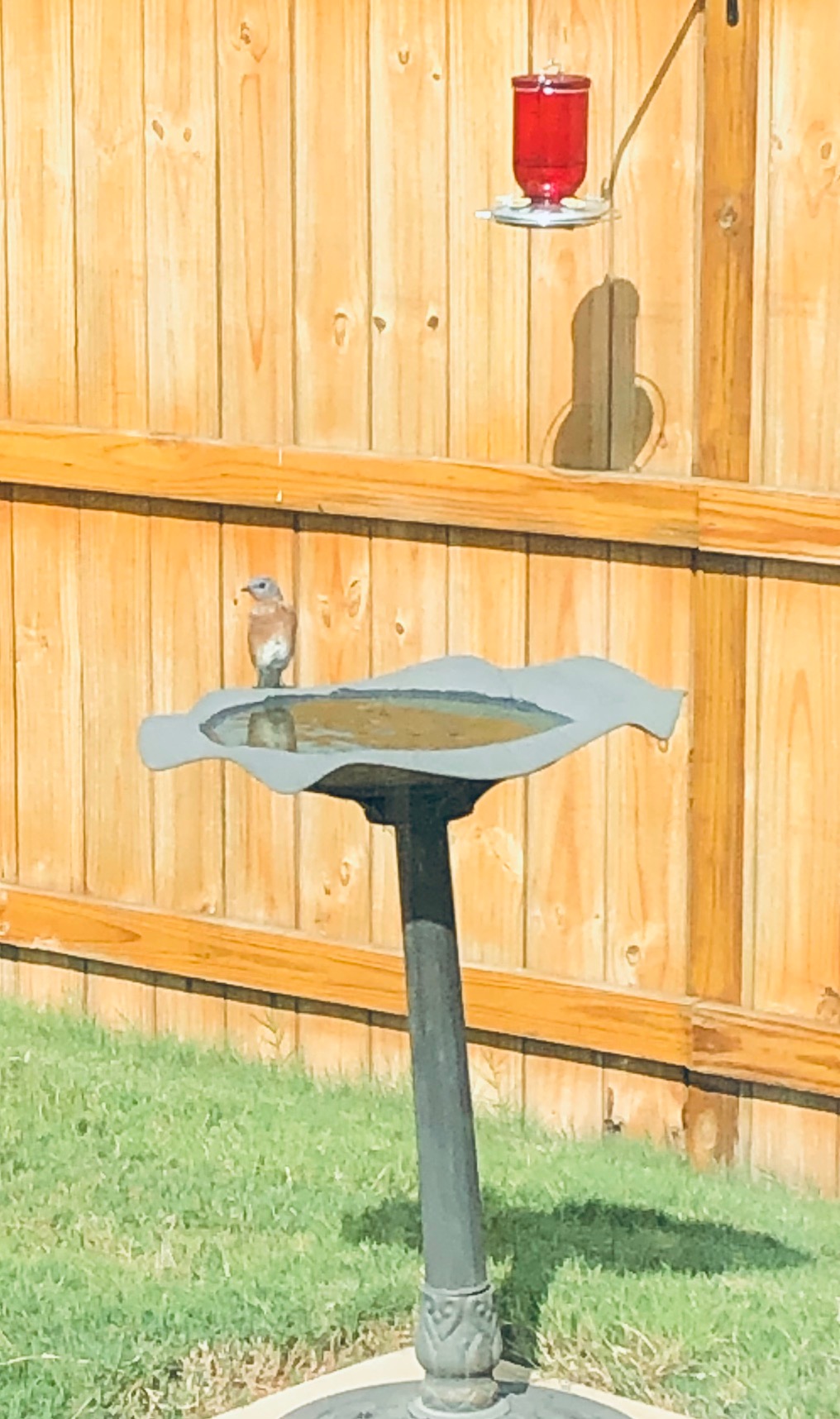
Larry (left) and Curly (right) enjoying the simple pleasures of summer.
Even while my backyard transitioned from a daycare to a teenage hang-out, my daily visitors have afforded me an opportunity to reflect on a much-needed reminder; some things have to change, some things we want to change, and even still, remarkably, some things don’t.
Moe, Curly, and Larry have been forced to grow up quickly (such is the life of a young bird) and that has required constant, daily transformation. Much of that change is good (the birds are now fully capable of caring for themselves), some of that change has been difficult to watch (I do miss coming home to the three little ones perched neatly underneath my reading chair), but even still, each bird has retained their essential nature as they have matured. Although they look almost identical, there is no doubt that all three have an individual and unique presence.
Collectively, these enduring qualities form the essence of a thing. Defined as “the intrinsic nature or indispensable quality of something” one’s essence is deep-seated, fundamental, and everlasting. Some call this essence the soul. As Eckhart Tolle has written “the soul is your innermost being. The presence that you are beyond form. The consciousness that you are beyond form, that is the soul. That is who you are in essence.”
Whatever you call it, I am grateful to have encountered it within each of my little bluebird friends this summer. Even though they changed right before my eyes unique and lasting defining characteristics remained unaltered. As someone who finds value in animal medicine, this revelation is consistent with the wisdom from that practice. Animal medicine draws from the premise that each species, in fact each individual creature, has a fundamental nature that belies changing circumstance, time, or alteration. How fitting it has been, I suppose, upon the death of a revered global figure and the beginning of the hurried pace of change that fall brings to the avian world, that I have been afforded the opportunity to experience the power of essence anew for these past several months.
I try my best not to begrudge change. As an acute observer of the natural world I recognize that evolution, growth, development, and even death are all essential parts of the tapestry. But sometimes rapid transformation can both unmoor you and leave you with a tinge of aimlessness. As I approach the season of fall in my corner of the world, my goal is to spend more time focusing on the essence of things, their innermost character and soul, rather than the many external modifications around me. After all, it is the essence of a thing – the good, bad, and ugly, that contribute to a legacy, far more than specific acts, possessions, or achievements. While the second Elizabethan era is over and Queen Elizabeth II has changed form once more, in her wake is an inspiring legacy and immutable essence.
I would like to hold that reality close over the winter months to come. Before long the water in my bird baths will chill and begin to freeze over. Even more substantial changes await my bluebird neighbors, shifts that will surely test their skills and fortitude. But I delight knowing that, just like the Queen, the innermost qualities of Moe, Curly, and Larry hold fast and continue, just as my own essence endures among the constant evolution of my life. And when I feel sadness and grief at inevitable loss and change within me or among others, I only have to tap into the essence of me, or it, or them – and I am comforted. Change is indeed constant, even while some things never will.
 Wisdom on Wings
What a great essay to pull lessons from the three stooges 🙂
LikeLike
wow!! 96Tipping the Scale Towards Joy, One Goldfinch at a Time
LikeLike